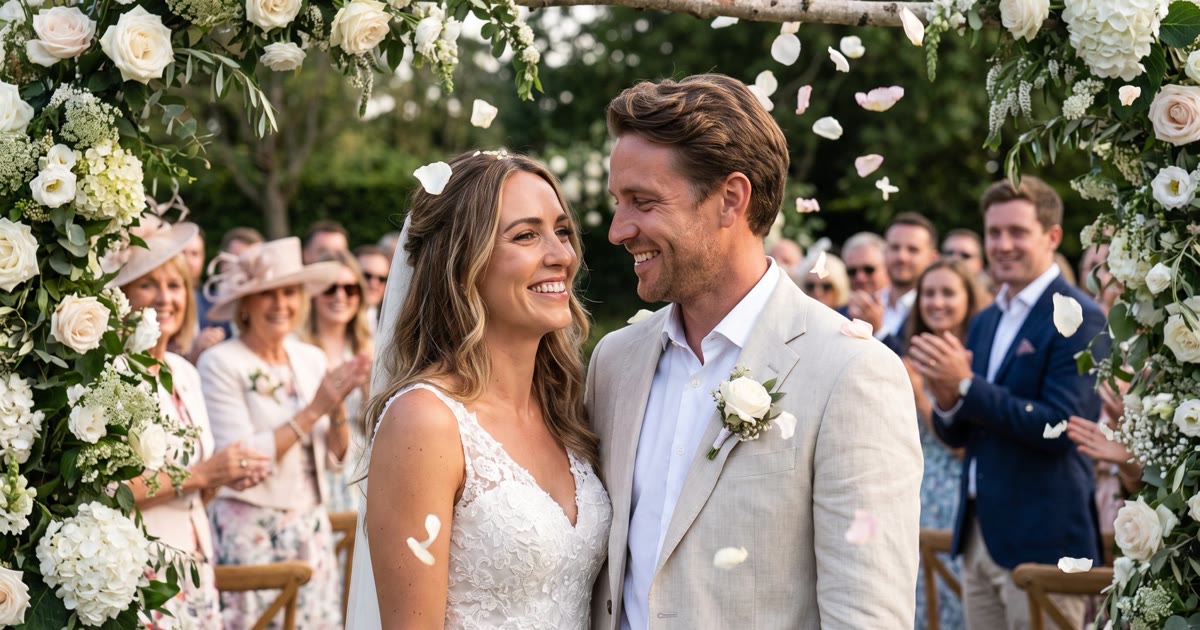
In a wedding card, congratulate both people by name, say one thing that is true about them or their day, and wish them something specific. Two to four sentences is enough. "Congratulations, Emma and Josh. Watching you plan this wedding without a single argument was the best advert for marriage we have ever seen. Have a wonderful first year" works for almost anyone who knows the couple a little.
Below are wishes grouped by who is writing, the same wish sized for a card, a toast and a text, traditional wording, a section on engagements and a short list of what to leave out. If you would rather start from your own couple, type their names and one thing about them into the box above. The agent asks who you are to them and what tone you want, then writes it. A text greeting costs nothing, and the first one needs no account.
Wedding card wishes by who you are to the couple
How well you know them decides how personal the card can be. A close friend can mention the pub quiz where they met. A colleague of the groom should not. Find the group that fits you, then swap the names and the detail for your own.
From a close friend
- "Priya, I have been hearing about Sam since the night you spent an hour deciding whether to text him back. You did, and look where we are. Congratulations to you both, and thank you for letting me stand next to you today."
- "Tom and Jess, you are the only couple I know who can build flat-pack furniture together and still be speaking afterwards. Marriage should be easy after that. Love you both."
- "To Lena and Marco: I have been friends with each of you for years, and the best thing either of you ever did was find the other. Have the best day, and save me a slow song."
- "Congratulations, you two. May your house always have a spare chair at the table for us, and may Ben never find out who really broke the barbecue."
From a brother, sister or relative
- "To my little brother and my new sister: Anna, I have waited years to call you that. Look after him, he's worth it. Welcome to the family and all its noise."
- "Dear Kate and David, your grandparents married in this same church fifty-one years ago, and today they are sitting in the second row. We hope your marriage is as long and as funny as theirs. With love, Aunt Carol and Uncle Mike."
- "Congratulations, Sophie and James. At your very first family dinner James offered to wash up, and he meant it. We knew then. So glad you're one of us."
From a colleague
- "Congratulations, Maya and Leo! Wishing you a wonderful day and a honeymoon with no laptops. See you back at work, but not too soon."
- "Dear Chris and Hannah, congratulations from everyone on the third floor. Chris has been smiling at his screen for months, and now we know why. Every happiness to you both."
- "Wishing you both a beautiful wedding and a happy marriage. Hannah, it's a pleasure to work with you, and lovely to share in some good news for once."
From a guest who barely knows them
If you are a plus-one or a distant relative, keep it short and honest. A plain line reads better than a closeness you do not have, and the couple will not expect more.
- "Congratulations, Olivia and Nate. Thank you for including me in such a happy day. Wishing you a long and happy marriage."
- "Congratulations to you both. I've only met you twice, and both times you were laughing at the same joke. That seems like a very good sign."
From the parents
- "To our daughter and our new son: today you promised each other what we promised thirty years ago. It is still the best promise we know. We love you both. Mum and Dad."
The same wish in a card, a toast and a message
A card is read at the table and again at home a week later. A toast is heard once, in a loud room, by people who may never have met you. A message lands on a phone next to forty others, so the same wish needs a different size in each place.
| Where it goes | Length | What it needs |
|---|---|---|
| Card with the gift | 2-4 sentences | Both names, one detail, one wish, your signature |
| Guest book or group card | 1 sentence | One warm line and your name, so the couple knows who wrote it |
| Toast | About a minute out loud | Who you are, one short story, both people, a raised glass |
| Message on the day | 1-3 sentences | Something readable between the hairdresser and the photos |
| Message when you can't go | 3-5 sentences | Sorry to miss it, then the wish, and no long excuse |
A short toast you can say out loud
The usual way a toast goes wrong is ten minutes about the friend and one line about the person they married. Keep it to one story, give both people a moment and end with the glass. This one takes about a minute:
"For those who don't know me, I'm Rachel, and I shared a flat with Emma for three years. In those three years she had one rule: never trust a man who doesn't like dogs. Then she met Josh, who is allergic to dogs, and she started buying him antihistamines. That's when I knew. Josh, thank you for making my best friend this happy. Everyone, please raise your glasses: to Emma and Josh.
You can get a toast from the agent too: give it the card wish and ask for "the same, as a one-minute toast". It keeps your details. Read it aloud once before the day and cut any line you would not say in your own voice.
When you can't be there
- "Emma and Josh, I'm so sorry to miss it. I'll be thinking of you at four o'clock when you walk down that aisle, and I expect photos of the first dance. Congratulations and all my love from Toronto."
- "Happy wedding day, you two! Go and enjoy every minute of it. Everything else can wait until Monday."
A message sent the evening before gets buried. Schedule it for the morning of the wedding instead; here is how to make a greeting arrive on the day.
Religious and traditional wording
Many couples, and their grandparents, like to see a traditional line. Use one when it belongs to the couple's faith or family, and put one sentence of your own after it so the card does not read like a printed insert.
Christian weddings
"May God bless your marriage" is the usual line, and many cards quote "Two are better than one" (Ecclesiastes 4:9) or "Love is patient, love is kind" (1 Corinthians 13:4).
- "Congratulations, Anna and Luke. May God bless your marriage and keep your home full of friends, music and good bread."
Jewish weddings
"Mazel tov" is right for any Jewish wedding. The traditional wish is that the couple build "a faithful house in Israel".
- "Mazel tov, Noa and Daniel! Wishing you a home full of Friday-night dinners, loud guests and a lot of love."
Muslim weddings
The blessing for newlyweds is "Barakallahu lakuma wa baraka alaykuma wa jama'a baynakuma fi khair": may Allah bless you both, send His blessing upon you and bring you together in goodness. Many people write only the first words, "Barakallahu lakuma".
- "Barakallahu lakuma, Sara and Karim. May your home be full of peace and your table always full of family."
If the couple's families speak Russian, Hebrew or Arabic, their customs go further than a single phrase: the cry of «Горько!» at a Russian wedding table, the words בניין עדי עד from the Hebrew wedding blessings, the old Arabic formula بالرفاء والبنين. The versions of this page in those languages cover them. You can also ask the agent to write the same wish in a second language for the other side of the family.
Congratulating an engagement
An engagement is news in its own right, and the easiest way to flatten it is to treat it as a trailer for the wedding: someone writes "We're engaged!" and the first reply is "So when's the wedding?". The couple has been engaged for a few hours. Let them enjoy it before anyone hands them a deadline.
Three things to leave out: the date question, marriage advice ("the secret is never going to bed angry") and jokes about losing freedom. What works is plain happiness and one line about why these two make sense. They chose each other on purpose, and that choice is the thing to congratulate.
- "Congratulations! I'm so happy for you both. Anyone who has seen you two together at a party knew this was coming."
- "She said yes! Josh, well done. Emma, you chose well. Next round is on me."
- "I've never seen you as calm about anything as you are about him. Congratulations, Priya. Best news of the year."
- "Congratulations on your engagement, Hannah and Chris. Enjoy this bit, before anyone mentions seating plans."
For a reply under an engagement post, one line is plenty: "Huge congratulations to you both, so happy for you!" is fine, and better than a lone emoji in a thread of forty.
What to leave out of a wedding wish
- Ex-partners, even as a joke, and even if the couple would laugh. Their grandparents will read the card too.
- "Finally!" or "About time". It sounds like a comment on how long they took.
- Divorce jokes, "ball and chain" and "last days of freedom". They mock the thing the couple is celebrating.
- Questions about children. The couple may have their own plans, or their own reasons for not talking about it.
- Advice nobody asked for. Unless you have been married for fifty years and they asked, skip the secret of a happy marriage.
- Money talk. "Hope this covers our dinner!" on the gift card makes the gift about you.
- A card to only one of them. Write to both of them, even if you only know one. For a second marriage, do not mention the first.
Writing it with the generator on this page
The box above opens a chat with our agent. It asks a few short questions, one at a time: who the couple are, who you are to them, what they are like, what tone you want. A few words per answer is enough. The more specific the first line you type, the fewer questions it needs.
What people usually type"wedding wish for a friend"
What works better"A card for Emma and Josh's wedding. I was Emma's flatmate at university. They met at a pub quiz and still argue about the answer that lost them the round. Warm, a bit funny, three sentences."
Then ask for changes in plain words: shorter for the guest book, a one-minute toast, less soppy, the same wish in Hebrew for Josh's grandmother. The agent writes in the language you write to it in and switches when you ask. Copy the result into the card, or send it by link or email.
If you want more than words, the same chat can make a photo card with the couple in it or a short video with sound. We made the clip below with Veo 3.1 from a still picture: newlyweds clink glasses on a terrace by the sea, with the waves and the cheering in the sound. The catalogue of scenes has ready wedding moments too, such as "First kiss as newlyweds"; you add the couple's photos and the faces become theirs. Photo cards and videos are paid in credits, the price is on the button before you press it, and sign-up gives 1 000 free credits.
Save the couple in your people with the wedding date, and next year a reminder arrives a week before the first anniversary, with a greeting ready. When that day comes, our page on anniversary wishes by year picks up where this one stops.
Wedding card questions
What do you write in a wedding card?
Congratulate both people by name, add one true line about them and finish with a wish for the years ahead. Two to four sentences is enough, for example: "Congratulations, Grace and Tom. You make every room you walk into happier. Wishing you a marriage full of good dinners and bad jokes." Sign with your name, or both names if you are a couple.
Should I say "congratulations" or "best wishes" at a wedding?
Either is fine today. Old etiquette kept "congratulations" for the groom and "best wishes" for the bride, because congratulating a bride was thought to suggest she had done well to catch a husband. Few people remember that rule now, and "Congratulations to you both" is the usual wording.
What do I write in a wedding card for someone I don't know well?
Keep it short and honest: thank them for inviting you, congratulate them both and wish them well. "Congratulations to you both, and thank you for including me in such a happy day" is enough. Do not invent a closeness you do not have. A plain line from a plus-one is exactly what the couple expects.
Is it OK to send a wedding wish by text?
Yes, for a couple you are not seeing that day, or as a short note on the morning of the wedding. Keep it to two or three sentences they can read in a spare minute. If you were invited and cannot go, send the message and a card or gift as well, because a text alone can feel thin next to an invitation.
Can the generator write a wedding toast?
Yes. Tell it who you are, one story about the couple and how long you have, and ask for a toast. About a minute suits most weddings. Read it aloud once before the day, cut anything you would not say in your own voice, and check that the story gives the partner as much room as your friend.
How do you congratulate someone on their engagement?
Say you are happy for them, add one line about why the two of them make sense, and stop there. "Congratulations! Anyone who has seen you two together knew this was coming" works for most people. Leave out the question about the wedding date, marriage advice and jokes about losing freedom.